how-to-choose-self-drilling-screw
Last updated: 3 Dec 2024
6299 Views
Self-Drilling Screws: A Comprehensive Comparison of Head Types
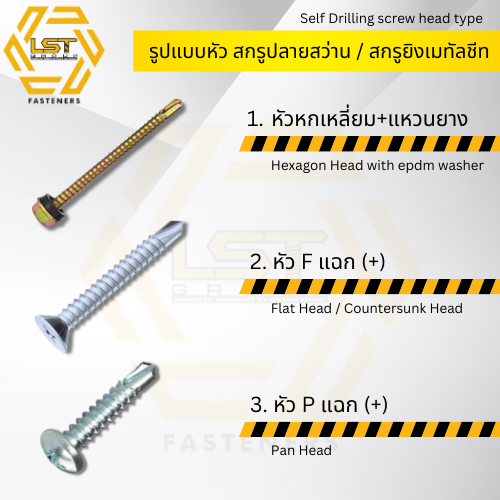
Self-drilling screws are essential fasteners in construction, manufacturing, and numerous industries. This guide provides an in-depth comparison of three popular self-drilling screw head types: Hexagon Head with EPDM Washer, Phillips Flat Head (Countersunk Head), and Phillips Pan Head.
## Understanding Self-Drilling Screws
Self-drilling screws are unique fasteners designed with a drill-like point that creates its own hole during installation, eliminating the need for pre-drilling and reducing labor costs.
## Comparative Analysis of Screw Head Types
### 1. Hexagon Head with EPDM Washer
**Advantages:**
- Provides maximum torque transfer
- Creates a watertight seal
- Excellent weather and UV resistance
- Absorbs vibration
- Compensates for surface irregularities
- Compatible with power tools and wrenches
- Ideal for outdoor and industrial applications
**Disadvantages:**
- Higher initial cost
- Requires precise installation technique
- Bulkier appearance
- May not be suitable for applications requiring a flush surface
**Best Suited For:**
- Roofing and cladding
- Solar panel installations
- Marine and coastal construction
- Agricultural equipment
- HVAC systems
- Exterior building facades
### 2. Phillips Flat Head (Countersunk Head)
**Advantages:**
- Sits flush with the surface
- Provides a clean, smooth aesthetic
- Reduces surface protrusion
- Minimizes snagging or catching
- Good for applications requiring a neat finish
- Distributes load evenly across the surface
- Allows for painting or finishing over the screw head
**Disadvantages:**
- Less torque transfer compared to hexagon head
- More challenging to drive
- Limited sealing capabilities
- Requires precise alignment during installation
- Can strip more easily if incorrect driver is used
- Reduced grip for tool engagement
**Best Suited For:**
- Woodworking
- Furniture manufacturing
- Interior finishing
- Decorative applications
- Where aesthetic appearance is crucial
- Surfaces requiring a smooth, flat finish
### 3. Phillips Pan Head
**Advantages:**
- Versatile design
- Provides good surface contact
- Easier to drive than flat head
- Better tool engagement
- Moderate profile
- Works well in many general applications
- Less prone to stripping compared to flat head
**Disadvantages:**
- Less precise sealing
- Reduced torque transfer
- Slightly raised profile
- Not as aesthetically smooth as flat head
- Limited weather resistance
- Less vibration absorption
**Best Suited For:**
- General construction
- Metal fabrication
- Electrical enclosures
- Machine assembly
- Interior and some exterior applications
- Where moderate profile is acceptable
## Comparative Performance Metrics
### Torque Transfer
1. Hexagon Head with EPDM Washer: Highest
2. Phillips Pan Head: Moderate
3. Phillips Flat Head: Lowest
### Sealing Performance
1. Hexagon Head with EPDM Washer: Excellent
2. Phillips Flat Head: Poor
3. Phillips Pan Head: Limited
### Aesthetic Finish
1. Phillips Flat Head: Smoothest
2. Phillips Pan Head: Moderate
3. Hexagon Head with EPDM Washer: Most Prominent
### Installation Ease
1. Phillips Pan Head: Easiest
2. Hexagon Head with EPDM Washer: Moderate
3. Phillips Flat Head: Most Challenging
## Key Considerations for Selection
When choosing between these head types, consider:
- Application environment
- Surface requirements
- Aesthetic preferences
- Load-bearing needs
- Sealing requirements
- Installation method
- Budget constraints
## Installation Tips
1. Use the correct driver type
2. Apply appropriate torque
3. Check surface compatibility
4. Consider environmental factors
5. Inspect seal and finish after installation
## Conclusion
Each screw head type offers unique benefits and limitations. The Hexagon Head with EPDM Washer excels in performance and sealing, the Phillips Flat Head provides a smooth finish, and the Phillips Pan Head offers versatility.
Select the head type that best matches your specific project requirements, balancing performance, aesthetics, and functionality.
## Recommended Resources
- Fastener Selection Guide
- Understanding Screw Head Mechanics
- Industrial Fastening Best Practices
*Disclaimer: Consult engineering professionals for specialized application requirements.*
Related Content
Ever wondered about those mysterious numbers on the Bolt's head? Let's dive into the world of high-strength fasteners and unravel the differences between grades 8.8, 10.9, and 12.9. Buckle up, DIY enthusiasts and engineering buffs we're about to get technical!
21 Mar 2024
Fake spring lock washer made from the ordinary mild steel, not from spring steel. Therefore, there is no feature that can lock the threads to prevent the loosening of screws or nut heads.
29 Apr 2024
Hex nuts, or what some call "female nuts," are essential components used in conjunction with bolts, screws, or male nuts to fasten various parts together. Although they may seem small, hex nuts come in a variety of materials, sizes, and properties, which directly affect their performance.
4 Jul 2024
