Partial Thread vs Full Thread Bolts
Last updated: 26 Aug 2025
9931 Views
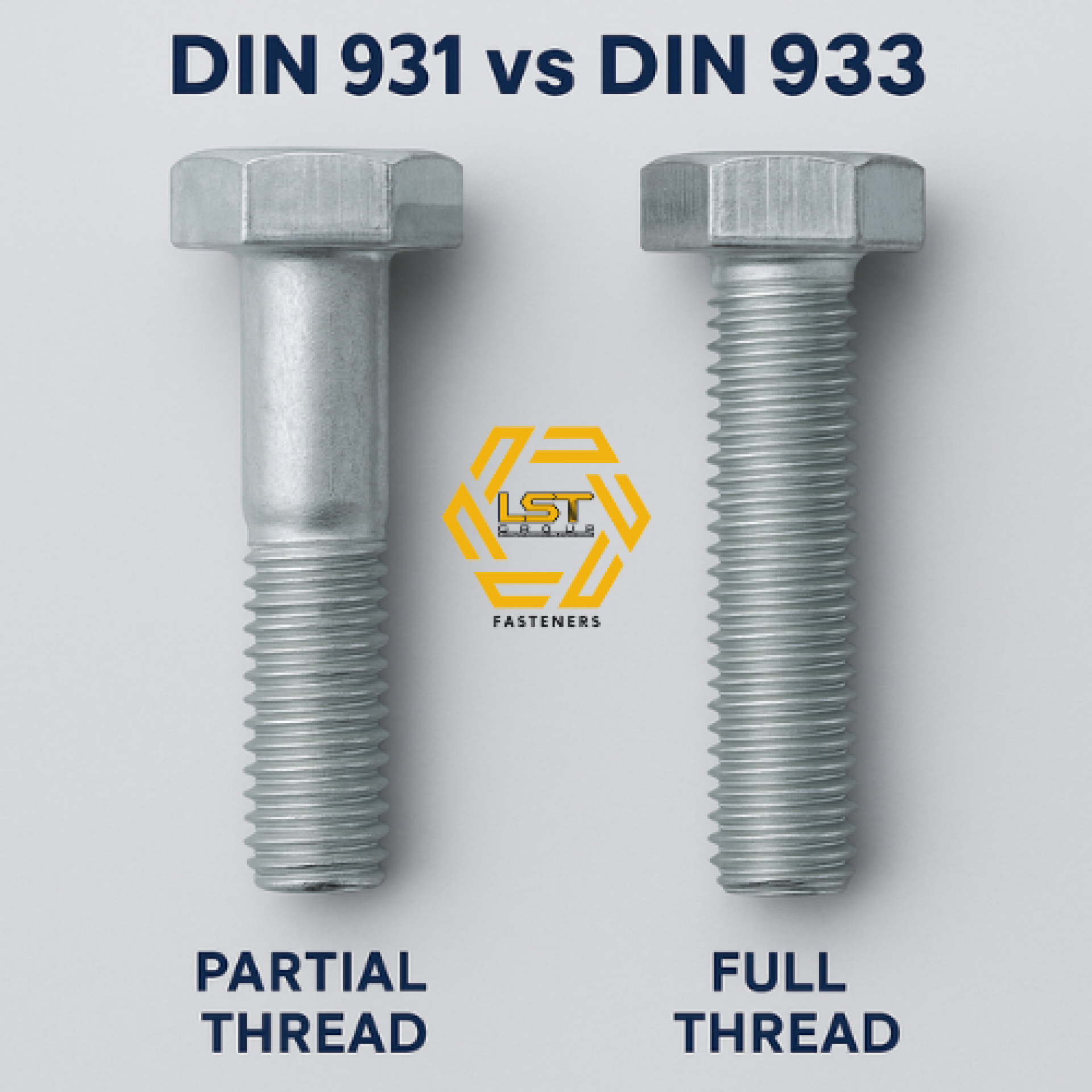
Which One Should You Choose? Heres What You Need to Know
When selecting bolts for your structural or mechanical projects, many buyers ask:
Should I go with partial-thread or full-thread bolts?
In this article, LST Group breaks down the differences to help you make the right decision.
Partial Thread Bolt (DIN 931)
Features:
- Smooth shank between the head and the threaded portion
- Standardized under DIN 931 (For Hex Bolt)
- Typically found with threads covering only part of the length
- Structural steel assemblies where the shank acts as a dowel to tightly secure two components
- Applications under high shear stress, such as beams, columns, or heavy machine frameworks
- Situations where threads inside the hole may reduce the connection strength
Full Thread Bolt (DIN 933)
Features:
- Threads run from under the head all the way to the tip
- Complies with DIN 933 standard (For Hex Bolt)
- Often used with nuts and washers in flexible assembly work
Ideal For:
- General-purpose fastening that requires adjustable engagement at multiple positions
- Repair, maintenance, woodwork, or installation where high shear stress is not a concern
- Situations where grip length is not critical and threading across the full body is preferred
So Which One is Right for You?
- If youre working on permanent steel structures, machinery, or load-bearing joints go for DIN 931 Partial Thread Bolts.
- If you need a flexible solution for general fixing, maintenance, or multi-position adjustment choose DIN 933 Full Thread Bolts.
Need Expert Advice?
Still unsure which one to pick?
Feel free to reach out to our bolt specialists:
- Line: @leesoonthai
- Facebook: LST Group - ทุกคำตอบของสกรูน๊อต
- Call us at: +66 2 8182555
- Website: https://grouplst.com
- E-mail: leesoonthai@gmail.com
Related Content
Compare 6 essential stud bolt grades, from Mild Steel to ASTM A193. Discover how to choose the exact threaded rod for your industrial projects right here.
28 Aug 2026

เหล็กกล้าไร้สนิมประเภท Austenitic (SUS-304, SUS-316 เป็นต้น) มีโครงสร้างผลึกที่เป็นแบบ FCC และเป็นโครงสร้างเดียวที่ไม่ทำให้เหล็กกล้าไร้สนิมเกิดความซึมซาบแม่เหล็ก แต่หากมีการเปลี่ยนแปลงสัดส่วนของโครงสร้างจุลภาคไปเป็นประเภทอื่นนอกจาก Austenitic ปริมาณมีมากพอก็จะทำให้มีสภาพสนามแม่เหล็กซึมซาบได้เกิดขึ้น
14 Apr 2024
When comparing Stainless Steel Self Drilling Screws with Yellow Zinc plated self drilling screws, there are different advantages and disadvantages as follows:
16 Jun 2024
