how-to-choose-self-drilling-screw
Last updated: 3 Dec 2024
4120 Views
Self-Drilling Screws: A Comprehensive Comparison of Head Types
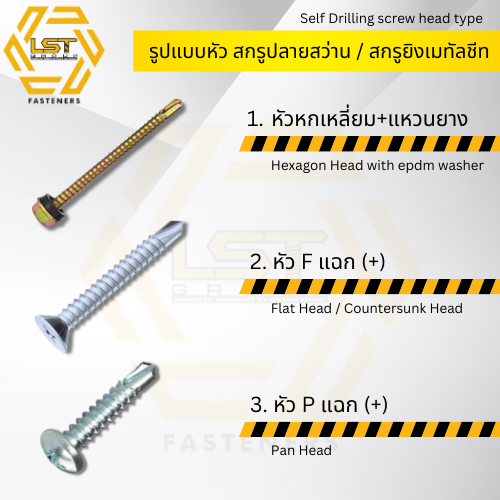
Self-drilling screws are essential fasteners in construction, manufacturing, and numerous industries. This guide provides an in-depth comparison of three popular self-drilling screw head types: Hexagon Head with EPDM Washer, Phillips Flat Head (Countersunk Head), and Phillips Pan Head.
## Understanding Self-Drilling Screws
Self-drilling screws are unique fasteners designed with a drill-like point that creates its own hole during installation, eliminating the need for pre-drilling and reducing labor costs.
## Comparative Analysis of Screw Head Types
### 1. Hexagon Head with EPDM Washer
**Advantages:**
- Provides maximum torque transfer
- Creates a watertight seal
- Excellent weather and UV resistance
- Absorbs vibration
- Compensates for surface irregularities
- Compatible with power tools and wrenches
- Ideal for outdoor and industrial applications
**Disadvantages:**
- Higher initial cost
- Requires precise installation technique
- Bulkier appearance
- May not be suitable for applications requiring a flush surface
**Best Suited For:**
- Roofing and cladding
- Solar panel installations
- Marine and coastal construction
- Agricultural equipment
- HVAC systems
- Exterior building facades
### 2. Phillips Flat Head (Countersunk Head)
**Advantages:**
- Sits flush with the surface
- Provides a clean, smooth aesthetic
- Reduces surface protrusion
- Minimizes snagging or catching
- Good for applications requiring a neat finish
- Distributes load evenly across the surface
- Allows for painting or finishing over the screw head
**Disadvantages:**
- Less torque transfer compared to hexagon head
- More challenging to drive
- Limited sealing capabilities
- Requires precise alignment during installation
- Can strip more easily if incorrect driver is used
- Reduced grip for tool engagement
**Best Suited For:**
- Woodworking
- Furniture manufacturing
- Interior finishing
- Decorative applications
- Where aesthetic appearance is crucial
- Surfaces requiring a smooth, flat finish
### 3. Phillips Pan Head
**Advantages:**
- Versatile design
- Provides good surface contact
- Easier to drive than flat head
- Better tool engagement
- Moderate profile
- Works well in many general applications
- Less prone to stripping compared to flat head
**Disadvantages:**
- Less precise sealing
- Reduced torque transfer
- Slightly raised profile
- Not as aesthetically smooth as flat head
- Limited weather resistance
- Less vibration absorption
**Best Suited For:**
- General construction
- Metal fabrication
- Electrical enclosures
- Machine assembly
- Interior and some exterior applications
- Where moderate profile is acceptable
## Comparative Performance Metrics
### Torque Transfer
1. Hexagon Head with EPDM Washer: Highest
2. Phillips Pan Head: Moderate
3. Phillips Flat Head: Lowest
### Sealing Performance
1. Hexagon Head with EPDM Washer: Excellent
2. Phillips Flat Head: Poor
3. Phillips Pan Head: Limited
### Aesthetic Finish
1. Phillips Flat Head: Smoothest
2. Phillips Pan Head: Moderate
3. Hexagon Head with EPDM Washer: Most Prominent
### Installation Ease
1. Phillips Pan Head: Easiest
2. Hexagon Head with EPDM Washer: Moderate
3. Phillips Flat Head: Most Challenging
## Key Considerations for Selection
When choosing between these head types, consider:
- Application environment
- Surface requirements
- Aesthetic preferences
- Load-bearing needs
- Sealing requirements
- Installation method
- Budget constraints
## Installation Tips
1. Use the correct driver type
2. Apply appropriate torque
3. Check surface compatibility
4. Consider environmental factors
5. Inspect seal and finish after installation
## Conclusion
Each screw head type offers unique benefits and limitations. The Hexagon Head with EPDM Washer excels in performance and sealing, the Phillips Flat Head provides a smooth finish, and the Phillips Pan Head offers versatility.
Select the head type that best matches your specific project requirements, balancing performance, aesthetics, and functionality.
## Recommended Resources
- Fastener Selection Guide
- Understanding Screw Head Mechanics
- Industrial Fastening Best Practices
*Disclaimer: Consult engineering professionals for specialized application requirements.*
Related Content
Today let's talk about screws. Or what many people call a "nut", but it's not an ordinary nut. We'll get to know the 10.9 grade screws, which are considered "superstars" in the field of mechanical engineering and automobile repair.
5 Aug 2024
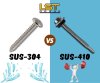
Selection of stainless steel screws between grades SUS-304 and SUS-410 should be based on the following properties of each grade: Corrosion resistance: SUS-304 It has significantly better corrosion resistance than SUS-410
20 Jun 2024

"สกรู" หรือที่หลายคนนิยมเรียกกันว่า "น็อตตัวผู้" นั้น มีวิธีเรียกเพื่อให้ผู้ซื้อและผู้ขายเข้าใจได้ตรงกันดังนี้
13 Mar 2024
